Introduction
Selecting diamond abrasives for metallographic sample preparation requires consideration of the specimen material, preparation stage, particle size, and product form. These factors determine how the abrasive should be selected and applied during the preparation process.
The specimen must be progressively prepared to remove cutting and grinding damage while preserving the material features that need to be examined under a microscope.
This guide explains how to select diamond abrasives for different metallographic preparation stages, how different diamond characteristics affect abrasive selection, and when diamond powder, suspension, or paste is appropriate for the preparation process.
What Is Metallographic Sample Preparation?
Metallographic sample preparation is the preparing a material specimen for examination and analysis of its internal microstructure[^1]. It is used to reveal features such as grain structure, phases, inclusions, pores, cracks[^2], and other characteristics that cannot be clearly observed on an untreated surface.
The process generally involves several stages, including sectioning, mounting, grinding, polishing, and, when required, etching. Each stage progressively prepares the specimen surface while minimizing damage or deformation that could affect the examination[^3].
Micron diamond powders are widely used for fine grinding and polishing in metallographic sample preparation. Depending on the preparation method and specimen material, mesh diamond grit can also be used for the earlier preparation stages. Through these stages, different diamond particle sizes are selected progressively to remove damage from the previous preparation step and refine the specimen surface.

How Do You Select Diamond Abrasives for Different Preparation Stages?
The particle size should be selected according to the condition of the specimen surface produced by the preceding preparation stage. These particle sizes are starting points rather than fixed requirements. The key selection principle is to avoid moving to a finer diamond before the previous stage has adequately removed its surface damage.
| Preparation stage | Diamond abrasive selection | What the abrasive needs to achieve |
|---|---|---|
| Sectioning | Diamond saw grit | Cut the specimen while limiting cutting damage that must be removed during subsequent preparation |
| Grinding | Diamond wheel grit appropriate for the amount of material removal required | Remove sectioning damage, irregularities, and surface deformation and establish a uniform surface for polishing |
| Intermediate polishing | Diamond micron powder, commonly around 9–3 μm depending on the preceding surface | Remove the scratches and deformation produced by grinding or the previous polishing step |
| Fine polishing | Fine diamond micron powder, commonly around 1 μm | Reduce the remaining fine scratches and surface deformation |
| Final polishing | Sub-micron or nano diamond powder when a finer surface is required | Further refine the surface for microscopic examination |
The appropriate sequence depends on the specimen material, starting surface, load, lubricant, equipment, and required examination condition.

Should You Choose Monocrystalline or Polycrystalline Diamond?
Both monocrystalline and polycrystalline diamond particles can be used for metallographic sample preparation. The choice should be based on the preparation stage, specimen material, and the surface result required from the abrasive.
Monocrystalline diamond is the preferred choice when the preparation requires a controlled, consistent abrasive action to remove the damage from the previous stage and establish a uniform surface for the next stage. It is particularly suitable when surface refinement and control of the resulting scratch pattern are priorities. Select the grade according to the required crystal strength, particle size, morphology, and PSD.
Polycrystalline diamond is the preferred choice when the preparation requires sustained cutting activity as the abrasive is used, particularly for stages where continued abrasive renewal can improve the removal of residual surface damage. Select the grade according to the required balance between material removal and surface refinement, then match its particle size, PSD, and fracture behaviour to the specimen and preparation conditions.

When Should You Choose Diamond Powder, Suspension or Paste?
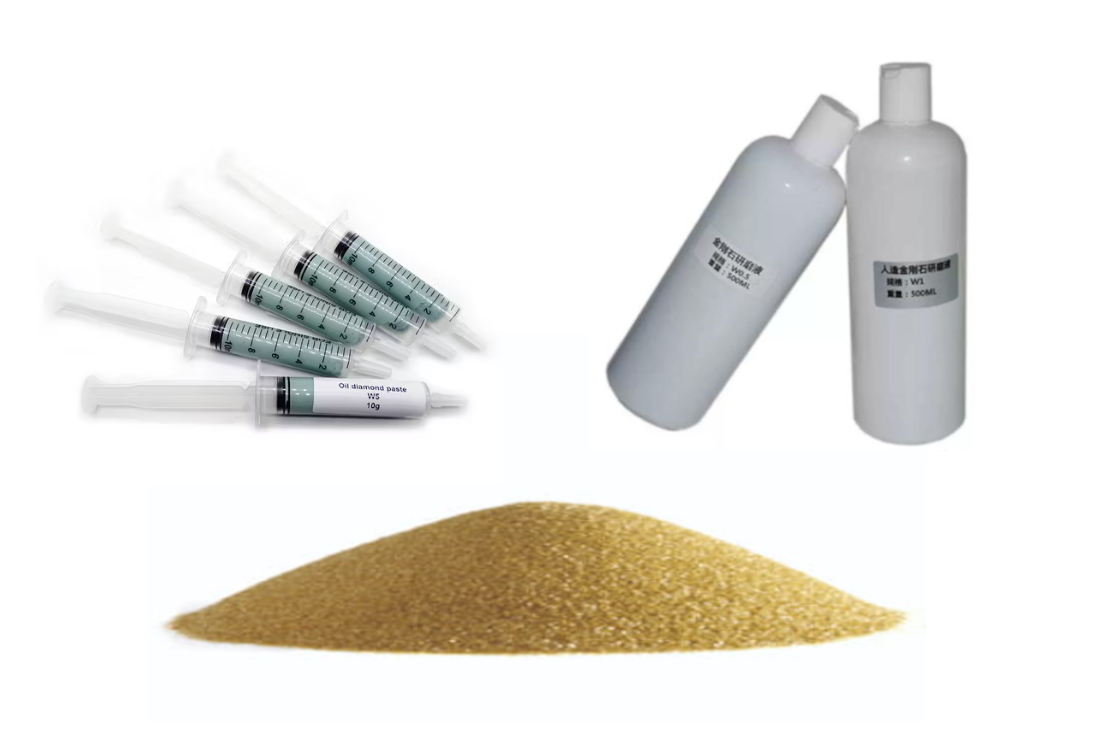
The choice between diamond powder, suspension and paste depends on how the abrasive needs to be prepared and applied during metallographic sample preparation. The product form determines how the diamond is introduced to the material surface and what aspects of abrasive delivery, lubrication and cleaning need to be controlled.
Diamond Powder
Loose diamond powder is suitable when the abrasive needs to be prepared by the user for a specific metallographic preparation stage. The powder can be mixed with a separately selected carrier or lubricant, giving the user direct control over the abrasive concentration and preparation conditions.
The main conditions to control are the diamond-to-carrier or lubricant ratio, abrasive concentration, lubricant type and application amount. These can be adjusted independently for different preparation stages, allowing the abrasive system to be adapted as the specimen progresses from material removal to finer surface preparation.
Diamond Suspension
Diamond suspension, also called diamond slurry, is suitable when the abrasive needs to be supplied as a liquid dispersion, particularly when controlled or automatic dripping is required[^4]. The diamond is dispersed in a carrier for application to the polishing surface.
The carrier liquid needs to be compatible with the polishing system and required lubrication conditions. Settling or agglomeration can change the concentration of diamond delivered to the polishing surface, so some formulations require shaking or agitation before use. The suspension should also be matched to the dispensing method, and attention should be given to whether the formulation provides sufficient lubrication or requires a separate lubricant. The carrier also affects cleaning between preparation stages.
Diamond Paste
Diamond paste is a concentrated, viscous abrasive formulation commonly applied directly to the polishing surface[^5]. It is suitable when the abrasive needs to be applied manually in a concentrated form, with the application method matched to the polishing cloth and preparation conditions.
The polishing cloth and application amount should be considered together, as excessive paste can accumulate on the working surface while insufficient paste can limit abrasive coverage. Depending on the formulation and polishing conditions, additional lubricant may be required. Paste residue should also be cleaned from the specimen, polishing cloth and equipment before changing to another preparation stage to prevent abrasive carryover.
Quick Selection Table
| Product form | Main considerations |
|---|---|
| Diamond powder | Diamond concentration, carrier or lubricant, application amount and polishing conditions |
| Diamond suspension | Carrier liquid, settling, agitation, lubrication, dispensing and cleaning |
| Diamond paste | Polishing cloth, application amount, lubrication and cleaning |
For more information of how to choose we have a full guide on selecting diamond slurry and paste
What Common Problems Affect Diamond Polishing Results?
Uneven Surface Finish
An uneven surface can result from inconsistent abrasive distribution, residual damage from the previous preparation stage, unsuitable polishing conditions, or inconsistent abrasive concentration. Check the specimen condition from the previous stage and verify the polishing surface, load, lubrication, and equipment conditions before changing the abrasive. If these factors are controlled, check the abrasive concentration and distribution and confirm that the selected diamond form and specification are suitable for the preparation stage.
Excessive Scratching
Excessive or persistent scratches can occur when the diamond abrasive is too coarse for the preparation stage, but may also result from residual damage from the previous step, contamination, an unsuitable or worn polishing cloth where applicable, excessive load, inadequate lubrication, or equipment conditions. Clean the specimen and polishing equipment thoroughly and check for abrasive carryover before changing the diamond specification. If scratching continues, check the polishing surface and process conditions, then review the diamond particle size, PSD, and abrasive distribution as potential contributing factors.
Slow Material Removal
Slow material removal can occur when the diamond grade is too fine for the preparation stage, but may also result from insufficient abrasive concentration, residual surface damage, unsuitable polishing conditions, inadequate load, insufficient lubrication, or ineffective abrasive contact with the specimen. Check the previous preparation stage and verify the polishing surface, load, lubrication, equipment conditions, and abrasive delivery before changing the diamond. If these factors are appropriate, review the diamond particle size, grade, concentration, and product form to determine whether the abrasive provides sufficient cutting action.
Abrasive Agglomeration
Agglomerated diamond particles can create localized scratching and inconsistent surface refinement. For diamond suspensions, check dispersion stability, settling, storage conditions, and mixing before use. For powder and paste, check that the abrasive is applied and distributed uniformly across the polishing surface. If agglomeration persists, check the application method, lubricant, and polishing surface for conditions that could cause uneven abrasive distribution.
Contamination Between Preparation Stages
Residual diamond abrasive from a previous stage can introduce unwanted scratches or interfere with subsequent polishing. Clean the specimen, polishing surface, and equipment thoroughly before changing to a finer abrasive grade, and where a polishing cloth is used, check that it has not retained abrasive from the previous stage. If contamination persists, use clean or dedicated application equipment between abrasive stages and review the cleaning procedure before changing the diamond specification.
How Can Crownkyn Help You Select the Right Diamond Abrasive for Metallographic Preparation?
Crownkyn supplies synthetic diamond powder, diamond slurry, and diamond paste for metallographic sample preparation. Diamond abrasives can be supplied in monocrystalline and polycrystalline structures, with controlled particle size, PSD, morphology, purity, and batch consistency to support different polishing stages and surface-finish requirements.
For an initial abrasive recommendation, contact Crownkyn and provide:
- Specimen material being prepared.
- Preparation method.
- Current diamond abrasive grade and grit sizes, if available
- Required preparations stages.
- Required surface finish.
Based on these parameters, our team can recommend a suitable starting grade, grit size, and abrasive characteristics for testing.
Diamond Abrasives for Metallographic Sample Preparation FAQs
Can diamond powder be used instead of diamond suspension for metallographic polishing?
Yes. Diamond powder can be used when the polishing process requires the abrasive to be prepared and applied separately from the carrier or lubricant. The powder must be adequately dispersed on the polishing surface to maintain consistent abrasive distribution during use.
Can diamond suspension be used for every metallographic polishing step?
Diamond suspension can be used across multiple polishing stages, but the required diamond size and suspension formulation change with the preparation stage. Coarser suspension is used for higher material removal, while finer suspension is used as the surface approaches the condition required for examination.
Why are scratches still present after diamond polishing?
Persistent scratches are not necessarily caused by the diamond grade. Check for contamination from a coarser abrasive, insufficient cleaning between preparation stages, abrasive particles becoming embedded in the polishing surface, or damage carried over from the previous step.
Why is diamond polishing removing material too slowly?
Low removal rate can result from an inappropriate diamond size, insufficient abrasive concentration, unsuitable abrasive characteristics for the specimen, or process conditions that limit effective contact between the abrasive and specimen. Increasing diamond size alone is not always the appropriate solution.
Can the same diamond grade be used for different metallographic materials?
Not necessarily. The same diamond size or product form can produce different cutting behaviour on different specimen materials. Hardness, toughness, deformation behaviour, and the surface condition produced by the preceding preparation step should be considered when selecting the abrasive grade.
Conclusion
Selecting the right diamond abrasive for metallographic sample preparation depends on the specimen, preparation stage, and required surface finish. Diamond powder, suspension, and paste provide different options for abrasive selection and application, while monocrystalline and polycrystalline diamond offer different cutting behaviours. Matching these factors to the preparation requirements helps achieve consistent and reliable polishing results.
References
[1] Development of polishing machine for preparation - Harvard Supports: Metallographic sample preparation is the process of preparing a material specimen for examination and analysis of its internal microstructure.
[2] Investigation on Microstructure and Mechanical Properties - University of Idaho.
Supports: Metallographic preparation is used to reveal grain structure, phases, inclusions, pores, cracks, and related microstructural characteristics.
[3] Optimization of preparation methods for EBSD analysis - Harvard. Supports: Each metallographic preparation stage should minimize damage or deformation that could affect microscopic examination.
[4] Development of spectral reflectometry characterization toward automation of polishing during sample preparation - Science Direct Supports: Use of diamond suspension with lubricant during automated metallographic polishing, including controlled polishing conditions and abrasive application.
[5] Dry sliding wear studies of aluminum matrix hybrid composites - Science Direct Supports: Use of diamond paste during metallographic polishing, with finer abrasive sizes used to further refine the surface after grinding.
Drafted by: Gareth Bayley
Technical Review & Editing: Ashley Wei