What Is Diamond Polishing Slurry? A Practical Guide to Selection and Use
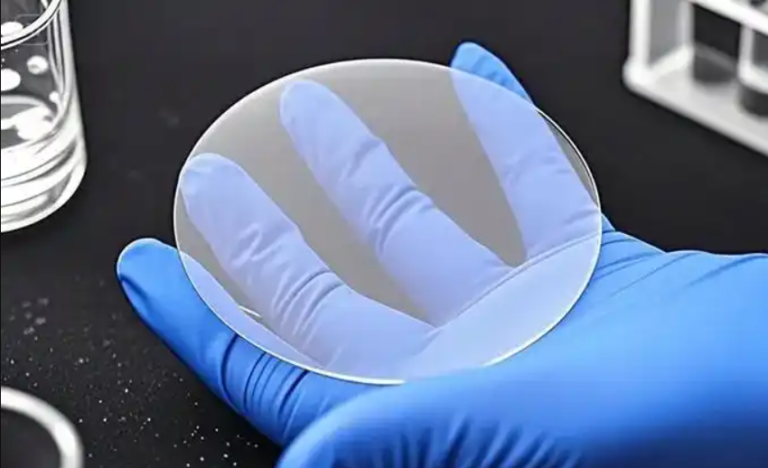
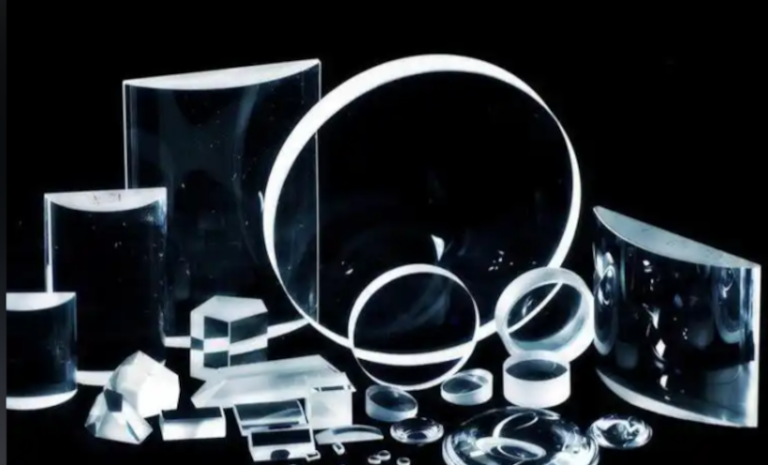
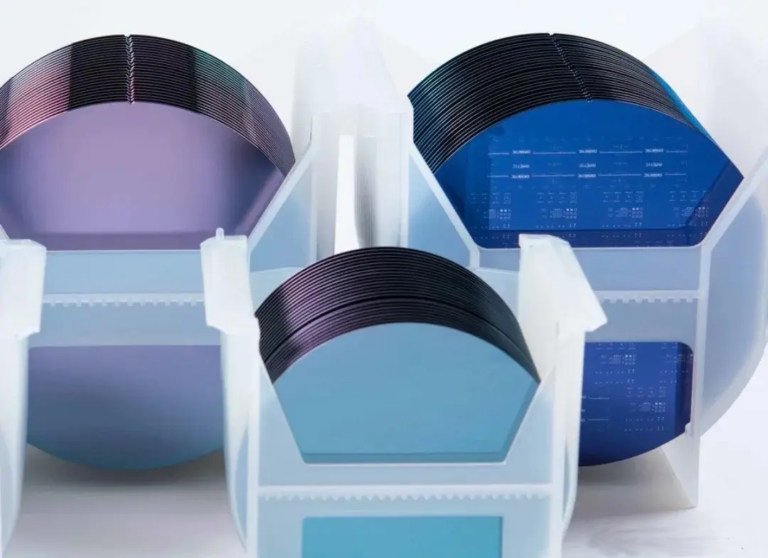
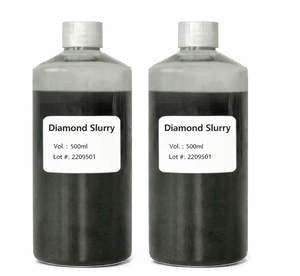
Diamond polishing slurry is a ready-to-use abrasive liquid made by dispersing synthetic diamond particles into a water-based or oil-based carrier[1]. It is used for precision lapping, polishing, and finishing of hard or brittle materials such as sapphire, ceramics, optical glass, silicon carbide, and tungsten carbide[1], as well as PCD/PCBN tools and precision metal parts.
Compared with loose diamond powder, a formulated diamond slurry is easier to use and more stable in production. The carrier liquid helps distribute diamond particles evenly, improve lubrication, remove heat, and carry polishing debris[2]. A stable formulation also helps reduce the risk of particle agglomeration[3]. In industrial applications, similar products may also be called diamond lapping slurry, diamond powder slurry, or diamond slurry for polishing.
The purpose of using diamond slurry is not only to create a bright surface. The real goal is to achieve controlled material removal, reduce random scratches, improve surface finish, and make polishing results repeatable from batch to batch.
What Is Diamond Polishing Slurry Made Of?
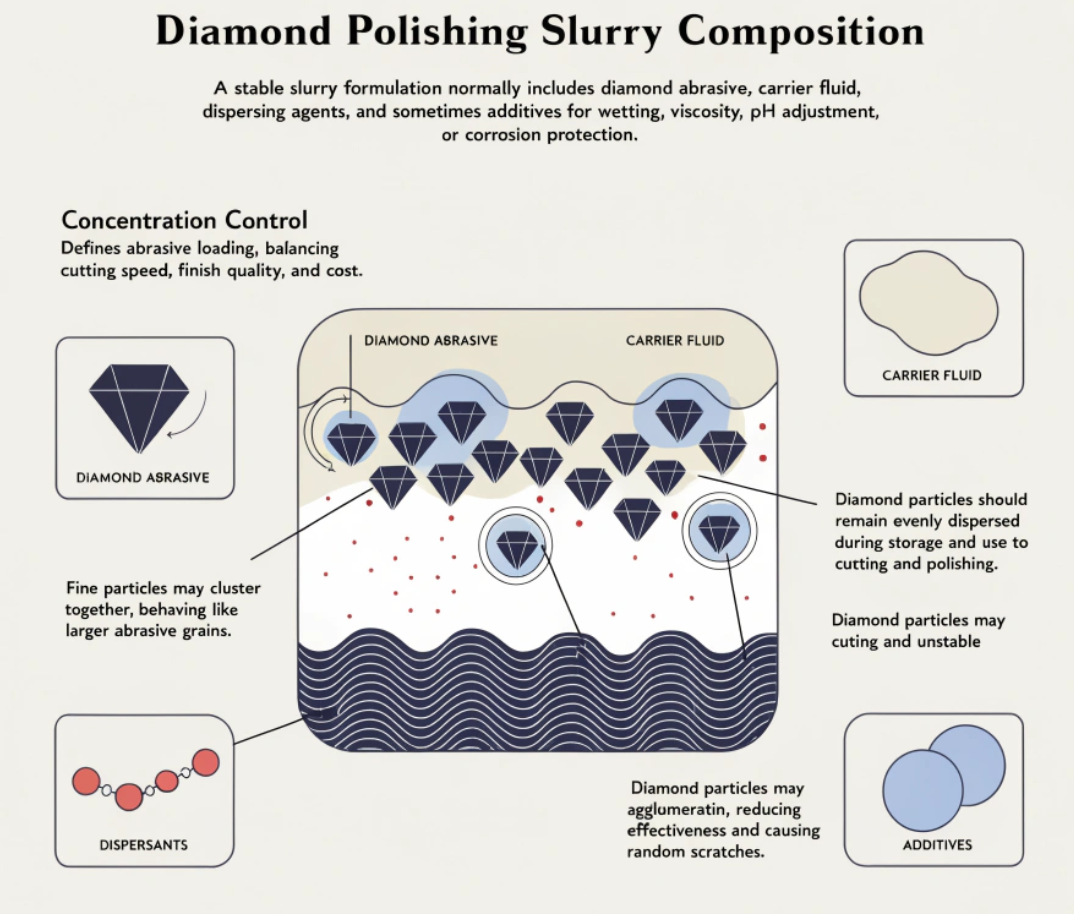
A diamond polishing slurry is not simply diamond powder mixed with liquid. A stable slurry formulation normally includes diamond abrasive, carrier fluid, dispersing agents[3], and sometimes additives for wetting, viscosity, pH adjustment, or corrosion protection.
| Component | Function | Why It Matters |
|---|---|---|
| Diamond abrasive | Performs micro-cutting and polishing | Controls removal rate and surface finish |
| Carrier fluid | Carries and disperses diamond particles | Affects lubrication, cooling, and cleaning |
| Dispersing agents | Help keep particles separated | Reduces agglomeration and random scratches |
| Additives | Adjust wetting, viscosity, pH, or corrosion behavior | Improves process compatibility |
| Concentration control | Defines abrasive loading | Balances cutting speed, finish quality, and cost |
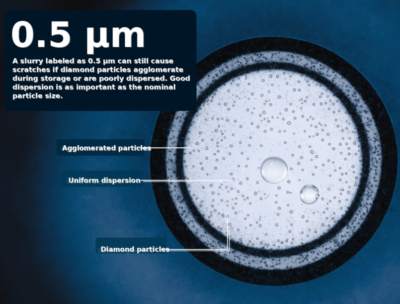
For a diamond powder slurry to work well, the particles should remain evenly dispersed during storage and use. If the formulation is unstable, fine particles may cluster together and behave like larger abrasive grains[4], which can lead to unexpected scratches.
When Should Diamond Slurry Be Used?
Diamond slurry is mainly used when conventional abrasives such as aluminum oxide, silicon carbide, or cerium oxide cannot provide enough cutting efficiency or surface control. This is common when the material is hard, brittle, wear-resistant, or difficult to finish consistently.
Common applications include:
- sapphire substrates and sapphire components;
- silicon carbide wafers and ceramics;
- alumina and zirconia ceramics;
- tungsten carbide tools and wear parts;
- optical glass and precision lenses;
- PCD, PCBN, and hard tool materials;
- mechanical seals and precision metal parts;
- laboratory sample preparation.
In my experience, many polishing problems are not caused by the diamond particles alone. They often come from a mismatch between particle size, carrier type, pad condition, slurry flow, cleaning method, and previous processing step. A better slurry helps, but the full process still needs to be controlled.
Diamond Polishing Slurry Particle Size: How to Choose
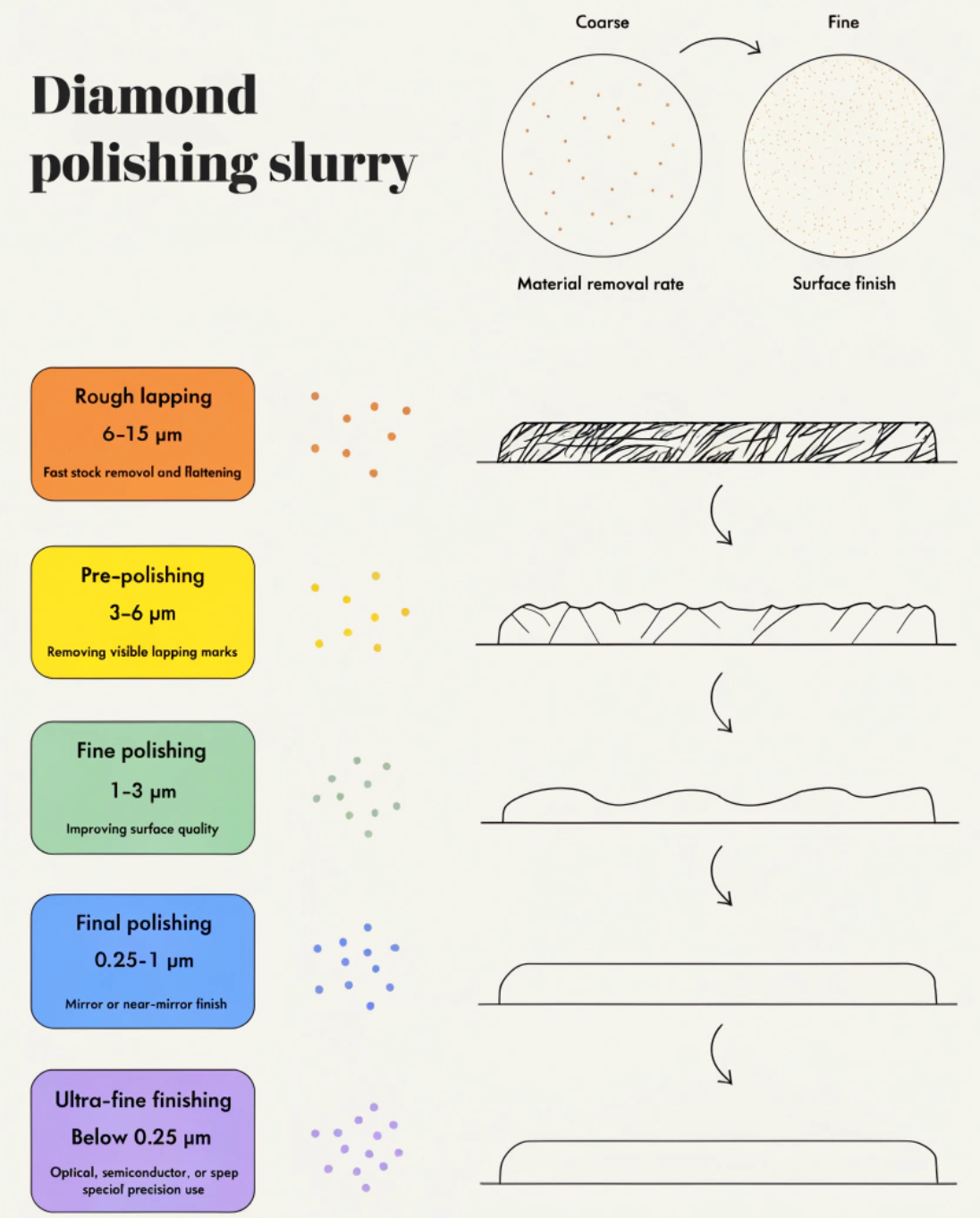
Diamond polishing slurry particle size directly affects material removal rate and final surface finish[5]. Coarser particles remove material faster, but they may leave deeper marks[5]. Finer particles can improve surface quality, but they may polish too slowly if used too early.
A practical polishing process usually uses step-by-step particle size reduction. Coarse slurry removes previous machining or lapping marks, while finer slurry gradually improves the surface.
| Process Stage | Common Particle Size | Typical Purpose |
|---|---|---|
| Rough lapping | 6–15 μm | Fast stock removal and flattening |
| Pre-polishing | 3–6 μm | Removing visible lapping marks |
| Fine polishing | 1–3 μm | Improving surface quality |
| Final polishing | 0.25–1 μm | Mirror or near-mirror finish |
| Ultra-fine finishing | Below 0.25 μm | Optical, semiconductor, or special precision use |
I usually do not recommend choosing the finest particle size at the beginning. If the previous step leaves deep scratches, moving directly to 0.25 μm slurry may only slow down the process. It is often better to use a proper intermediate size, such as 3 μm or 1 μm, before final polishing.
Water-Based Diamond Slurry vs. Oil-Based Diamond Slurry
The carrier fluid has a strong influence on polishing performance. It affects particle dispersion, lubrication, cooling, cleaning, corrosion behavior, and compatibility with the workpiece and polishing pad.
Water-Based Diamond Slurry
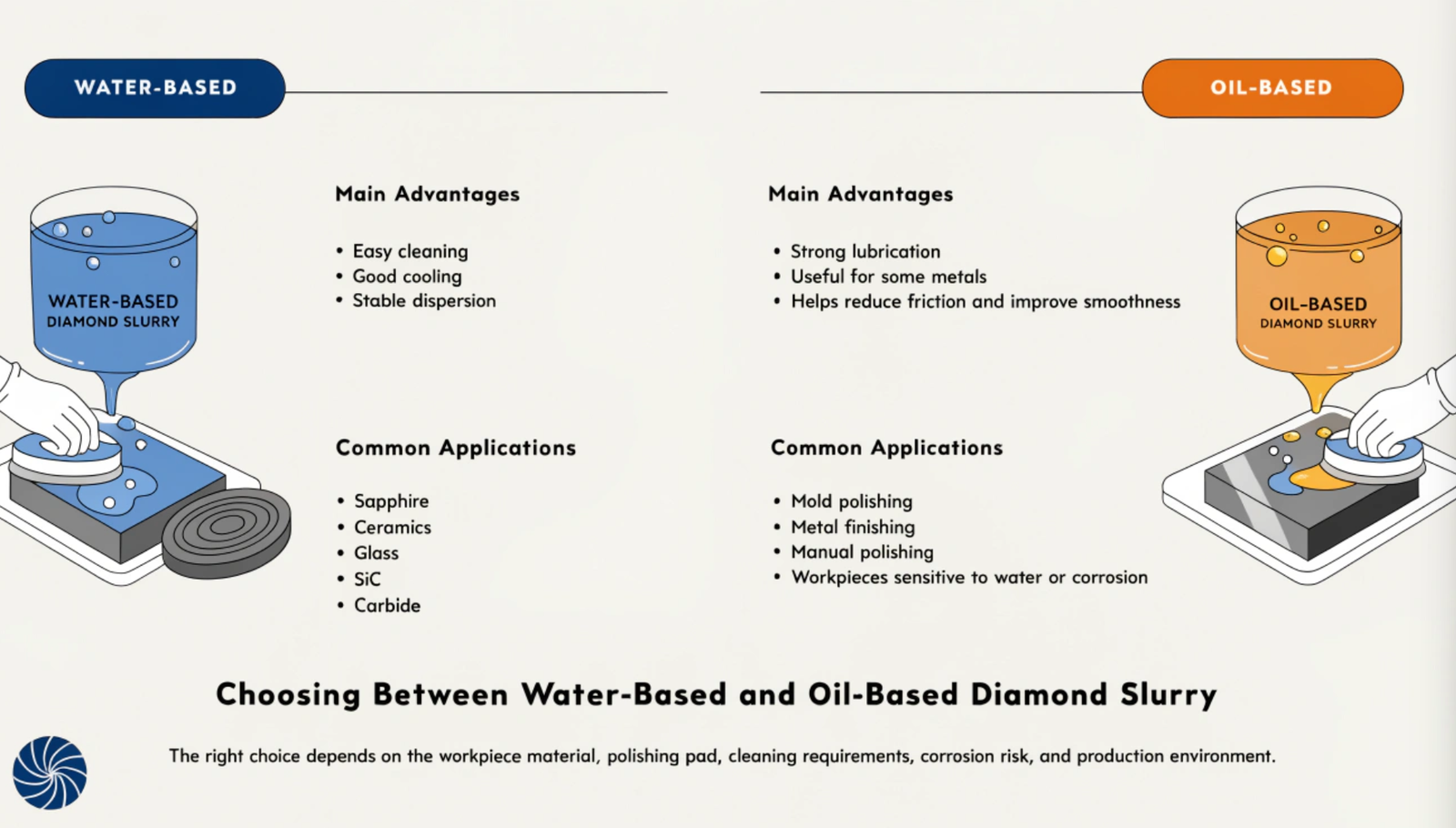
Water-based diamond slurry is widely used for ceramics, sapphire, optical glass, silicon carbide, tungsten carbide, and many precision polishing applications. It is easier to clean, provides good cooling, and can be adjusted with dispersants and additives.
A water-based diamond slurry is often preferred when the process requires clean operation, easy post-polishing cleaning, and stable particle suspension.
Oil-Based Diamond Slurry
Oil-based diamond slurry provides stronger lubrication and can be useful for mold polishing, metal finishing, manual polishing, and workpieces that are sensitive to water or corrosion. It can help reduce friction and improve smoothness in some applications, but cleaning is usually more difficult than with water-based systems.
| Carrier Type | Main Advantages | Common Applications |
|---|---|---|
| Water-based diamond slurry | Easy cleaning, good cooling, stable dispersion | Sapphire, ceramics, glass, SiC, carbide |
| Oil-based diamond slurry | Strong lubrication, useful for some metals | Mold polishing, metal finishing, manual polishing |
The right choice depends on the workpiece material, polishing pad, cleaning requirements, corrosion risk, and production environment.
Common Diamond Slurry Concentrations: 50 ct/L, 100 ct/L, and 200 ct/L
Crownkyn can provide diamond slurry in different concentration levels, including 50 ct/L, 100 ct/L, and 200 ct/L. A lower concentration is often used for fine polishing, trial testing, or applications with lower removal requirements. A medium concentration is suitable for general lapping and polishing. A higher concentration can be considered when the process requires faster removal or more stable production output.
In my experience, the best concentration should be confirmed by testing under the same machine, pad, pressure, and slurry flow conditions. The goal is to achieve the required finish with stable removal and reasonable slurry consumption.
Diamond Slurry Dispersion and Concentration: Why They Matter
Particle dispersion is one of the most important quality factors in diamond slurry[4]. A slurry labeled as 0.5 μm can still create random scratches if the particles agglomerate during storage or polishing. Good dispersion helps the slurry behave according to its nominal particle size.
Concentration also matters. Higher diamond concentration can increase cutting activity[5], but more diamond powder does not always mean better performance. If the concentration is too high, particles may interfere with one another, generate more heat, increase waste, or reduce surface stability.
| Requirement | Practical Direction |
|---|---|
| Faster material removal | Use a larger particle size or slightly higher concentration |
| Better surface finish | Use finer particles with stable dispersion |
| Fewer random scratches | Improve cleaning, filtration, and slurry stability |
| Lower cost per part | Optimize concentration instead of simply increasing abrasive loading |
| Better repeatability | Control slurry flow, pad condition, and polishing time |
For industrial use, I usually suggest testing two or three concentrations under the same machine conditions. This gives a more reliable result than assuming the highest concentration is always the best. Crownkyn can supply different concentration options, such as 50 ct/L, 100 ct/L, and 200 ct/L, depending on the required removal rate and surface finish.
Monocrystalline or Polycrystalline Diamond Slurry?
Both Monocrystalline diamond slurry and Polycrystalline diamond slurry can be used for lapping and polishing, but they behave differently.
Monocrystalline diamond particles are single-crystal grains. They usually provide strong cutting action and are suitable for applications that require efficient material removal on hard materials.
Polycrystalline diamond particles are made of many small diamond micro-crystals. During polishing, the multi-grain structure can expose fresh cutting edges[6], which may help produce a more controlled finish in fine polishing applications.
| Category | Monocrystalline Diamond Slurry | Polycrystalline Diamond Slurry |
|---|---|---|
| Particle structure | Single crystal | Multi-grain structure |
| Cutting behavior | Strong and direct cutting | Multi-edge micro-cutting |
| Surface finish | Suitable for efficient lapping and polishing | Often used for fine and mirror polishing |
| Scratch control | Depends on particle size and dispersion | Often better for controlled fine finishing |
| Typical use | Hard materials, rough to fine polishing | Brittle materials, precision polishing, final finish |
There is no single best choice for every application. The right option depends on material hardness, target surface finish, removal rate requirement, process stability, and cost.
Recommended Diamond Slurry by Application and Particle Size
The following ranges are general starting points. Final selection should be confirmed through testing because material grade, previous process, pad type, pressure, speed, and machine condition can all change the result.
| Application | Common Slurry Type | Typical Particle Size |
|---|---|---|
| Sapphire polishing | Water-based diamond slurry | 0.25–3 μm |
| Ceramic polishing | Water-based diamond slurry | 0.5–6 μm |
| Tungsten carbide polishing | Water-based or oil-based slurry | 1–6 μm |
| Optical glass polishing | Fine diamond slurry | 0.1–1 μm |
| Mold polishing | Oil-based diamond slurry or diamond paste | 1–9 μm |
| PCD/PCBN finishing | Diamond slurry or diamond paste | 1–15 μm |
| Laboratory sample preparation | Water-based diamond slurry | 0.25–9 μm |
| Ultra-fine finishing | Fine diamond slurry or nano diamond slurry | Below 0.25 μm or nano-scale |
These recommendations can be used as starting points for diamond slurry for sapphire polishing, diamond slurry for ceramic polishing, diamond slurry for tungsten carbide polishing, diamond slurry for optical glass polishing, and diamond slurry for PCD/PCBN finishing.
For production customers, I would first confirm the current surface condition and target roughness before recommending a product. A slurry that works well for final polishing may not be suitable for removing deep lapping marks. For applications requiring an even finer surface finish, Nano diamond slurry can also be considered, depending on the material and polishing process.
How to Use Diamond Slurry in a Stable Polishing Process
A consistent polishing result depends on the complete process, not only the slurry itself. Pad type, pad condition, pressure, speed, slurry flow, cleaning, and operator habits all affect the final surface.
Basic process suggestions:
- Select the particle size based on the previous surface condition.
- Choose water-based or oil-based slurry according to the workpiece and cleaning requirements.
- Shake or stir the slurry before use to ensure uniform suspension.
- Apply slurry evenly to the polishing pad or plate.
- Keep enough slurry flow to avoid dry polishing and overheating.
- Clean the workpiece, pad, tank, tubes, and fixtures between particle size changes[7].
- Monitor surface roughness, scratch levels, and removal rate during testing.
- Adjust pressure, speed, flow rate, and polishing time based on actual results.
| Problem | Possible Cause | Adjustment Direction |
|---|---|---|
| Random deep scratches | Agglomeration or contamination | Improve cleaning, filtration, and storage |
| Low removal rate | Particle size too fine or concentration too low | Use coarser size or adjust concentration |
| Poor surface uniformity | Uneven slurry flow or pad wear | Improve dispensing and pad conditioning |
| Workpiece heating | Insufficient lubrication or excessive pressure | Increase slurry flow or reduce pressure |
| Unstable results | Settling, pad glazing, or inconsistent cleaning | Standardize mixing, pad maintenance, and cleaning steps |
Is Diamond Slurry the Same as CMP Slurry?
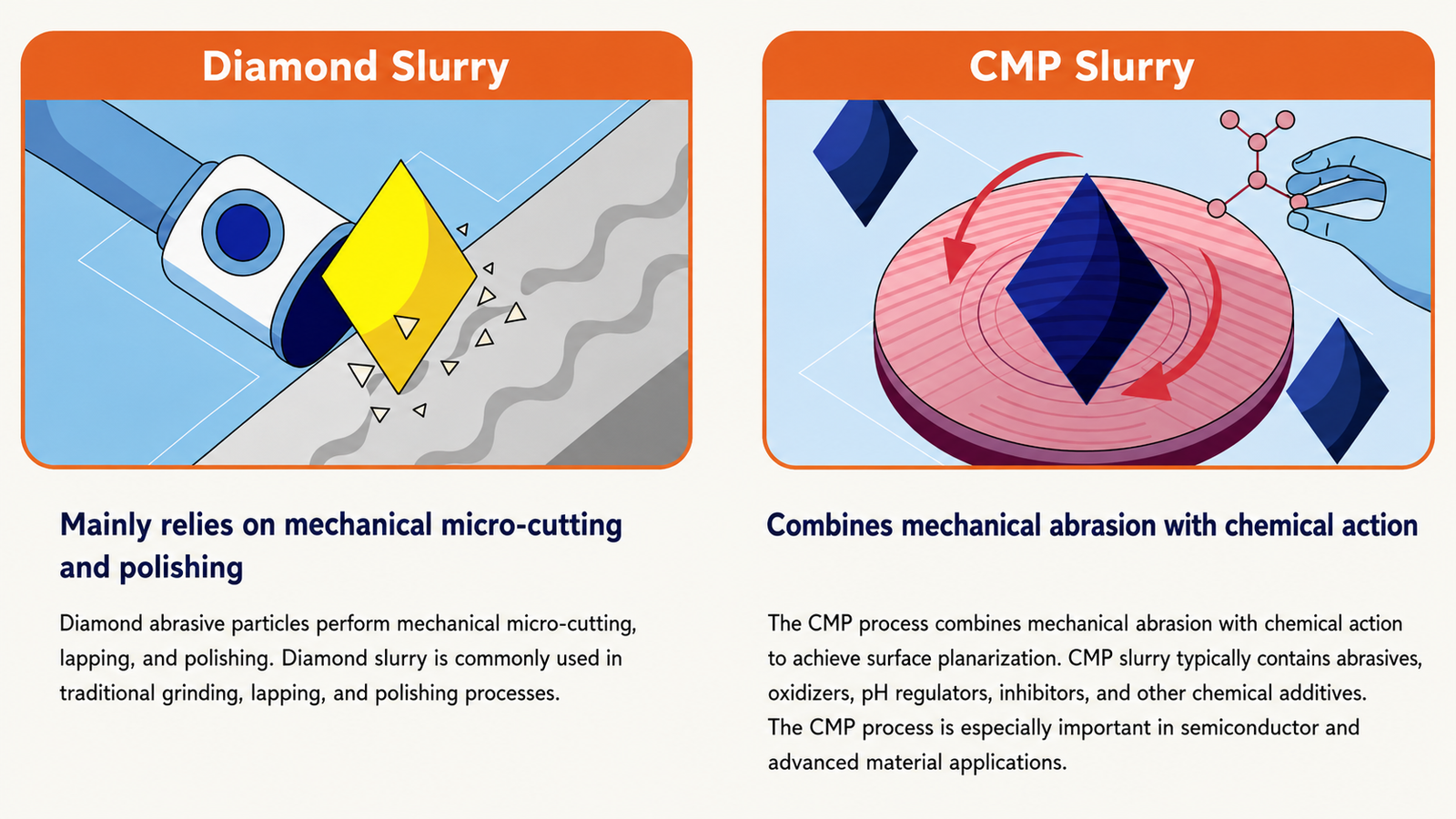
Diamond slurry can be used in some polishing and planarization processes, but standard diamond polishing slurry is not always the same as CMP slurry. Chemical mechanical polishing, or CMP, uses both mechanical abrasion and chemical action during surface planarization[8]. A CMP slurry may include oxidizers, pH regulators, corrosion inhibitors, or other chemical components designed for a specific material system.
Standard diamond slurry mainly provides mechanical micro-cutting and polishing. If the process requires CMP performance, the formulation must be matched with the workpiece material, pad, equipment, and surface chemistry. This is especially important in semiconductor and advanced material applications.
How Crownkyn Helps You Choose the Right Diamond Slurry
When helping customers choose diamond slurry for polishing or diamond slurry for lapping, I usually start with a few basic process details. The goal is not to make the inquiry complicated, but to avoid recommending a generic slurry that may not match the actual material, surface finish target, or polishing process.
Crownkyn can supply different diamond slurry options for different finishing needs, including monocrystalline diamond slurry, polycrystalline diamond slurry, nano diamond slurry, and agglomerated diamond slurry.
- Monocrystalline diamond slurry is often used when efficient cutting and stable material removal are required.
- Polycrystalline diamond slurry is suitable for fine polishing applications where controlled finishing and scratch reduction are important.
- Nano diamond slurry can be considered for ultra-fine polishing or applications requiring a very fine surface finish.
- Agglomerated diamond slurry uses near-spherical agglomerated particles to provide stable cutting, reduced scratches, and consistent surface quality on hard and brittle materials.
To make the first recommendation easier, you can simply share:
- the material to be polished, such as sapphire, ceramic, carbide, glass, SiC, PCD, or metal parts;
- the polishing purpose, such as rough lapping, fine polishing, mirror finishing, ultra-fine finishing, or sample preparation;
- the preferred diamond polishing slurry particle size, water-based diamond slurry, or oil-based diamond slurry, if already known;
- the testing quantity or expected production use.
If some details are not clear, that is also fine. Crownkyn and our team can help review the application and suggest a suitable diamond slurry, diamond lapping slurry, or diamond powder slurry option for initial testing. For more precise recommendations, information such as target surface roughness, polishing pad type, machine conditions, and required concentration can be added later.
Conclusion
Diamond Polishing Slurry is a practical polishing consumable for hard and brittle materials where surface finish, scratch control, and process repeatability matter. The best result usually comes from matching particle size, diamond type, carrier fluid, concentration, pad condition, and machine parameters.
For many production problems, the solution is not simply choosing the finest size or the highest concentration. A stable step-by-step process, good dispersion, proper cleaning, and consistent slurry flow often make a bigger difference.
If you are selecting a diamond slurry for a new material or improving an existing polishing process, Crownkyn can help review the application details and recommend a suitable water-based diamond slurry, oil-based diamond slurry, monocrystalline diamond slurry, or polycrystalline diamond slurry for testing.
References
[1] Examination of the Material Removal Rate in Lapping - OAKTrust
Supports diamond slurry use in lapping and polishing.
[2] Particle Flow & Tribology Lab - Carnegie Mellon University
Supports particle flow, lubrication, and debris transport in polishing systems.
[3] The Stability Evaluation of Ceria Slurry Using Polymer Dispersants - PMC
Supports dispersion stability and agglomeration control in slurry systems.
[4] Slurry Abrasive Particle Agglomeration - MIT
Supports the effect of abrasive particle agglomeration in slurry polishing.
[5] Developing an Analytical Model for Optimizing Polishing Parameters - PMC
Supports the effect of particle size and concentration on polishing performance.
[6] Polycrystalline Diamond Polishing - PACE Technologies
Supports the use of polycrystalline diamond abrasives in fine polishing.
[7] Polishing Procedure - Carnegie Mellon University
Supports cleaning between polishing steps to avoid contamination.
[8] Chemical Mechanical Planarization - HORIBA
Supports the difference between CMP and ordinary mechanical polishing.