What Are CMP Pad Conditioners?
A CMP pad conditioner uses diamond abrasives to dress, roughen, and open the pores of chemical-mechanical planarization (CMP) polishing pads, helping maintain a consistent pad cut rate and slurry flow during semiconductor fabrication.
A conventional diamond pad conditioner consists of a carrier substrate with individual diamond grit particles secured to its working surface. Conditioner designs differ in diamond arrangement, spacing, and protrusion, as well as the bonding system used to retain the abrasive particles.
Why Are Diamond Abrasives Used in CMP Pad Conditioners?
CMP pad conditioner diamond must dress the pad without creating avoidable wafer risk. Diamond’s high hardness and wear resistance allow abrasive particles to cut the polishing pad surface and maintain its texture through repeated conditioning cycles. This action removes glazed surface material and exposes fresh pad material, helping preserve slurry transport and consistent polishing performance.
Diamond grit also provides discrete cutting points that can be arranged across the conditioner’s working surface. Controlling their spacing, orientation, and protrusion allows the conditioner to produce the required pad texture and pad wear rate.
What Diamonds Are Used in CMP Pad Conditioners?
CMP pad conditioners rely on coarse mesh-size monocrystalline synthetic diamond grits—typically ranging from 80/100 to 170/200 US mesh (roughly 75 to 180 µm)—chosen to match the target pad groove geometry and material removal rate. Rather than relying on random crushing, conditioner disks require grits sorted for consistent crystal aspect ratio so individual grains can be positioned at uniform working heights across the carrier face.
Selection and specification at the disk level center on three CMP-specific factors:
- Working-Tip Geometry (Point vs. Face Exposure): Crystals are selected and positioned to present controlled cutting edges or crystal corners to the polyurethane pad. Point-oriented tips penetrate glazed pad surfaces with lower downforce, whereas flatter crystal faces produce gentler micro-roughness and lower pad wear rates.
- Mesh Size vs. Slurry and Layer Requirements: Coarser mesh grades (e.g., 80/100 to 100/120) are typically used for aggressive oxide or tungsten (W) CMP conditioning where higher pad cut rates are needed, while finer mesh grades (e.g., 140/170 to 170/200) are favored for copper (Cu) and barrier CMP to create finer pad asperities and reduce wafer scratch risk.
- Batch-to-Batch Dimensional Consistency: Because conditioner life is measured across thousands of wafer passes, tight control over grit size and shape consistency ensures the pad cut rate remains stable from break-in through end-of-disk life.
How Do Grit Layout and Bonding Systems Control Pad Conditioning?
How diamond grits are spaced and anchored to the carrier disk determines both pad cutting efficiency and operational safety inside the fab.
Random vs. Patterned Grit Placement
- Random distribution places diamond particles irregularly across the disk face. While simpler to manufacture, variations in local grain density can cause uneven pad wear or allow clustered grains to shield neighboring tips from contacting the pad.
- Patterned (arrayed) placement positions individual diamond crystals at controlled intervals. Uniform spacing ensures each active grain carries an equal share of the applied downforce, producing predictable pad roughness and more consistent slurry channels across the pad radius.
Bonding Systems (Brazing, Electroplating, and Sintering)
- Active brazing chemically bonds diamond grits to a stainless-steel substrate using a titanium- or chromium-containing braze alloy. Chemical wetting allows higher diamond protrusion heights—creating more clearance for pad debris and slurry flow—while maintaining strong particle retention.
- Electroplating locks diamond particles into a deposited nickel layer. While cost-effective, retention is primarily mechanical, which limits safe protrusion height before grits risk loosening under cyclic shear.
- Sintered metal bonds embed diamond particles within a consolidated metal matrix, distributing mechanical loads across the bond layer for extended wear life in heavy-duty conditioning applications.
What Causes CMP Conditioner Failure and Wafer Defects?
In semiconductor manufacturing, a pad conditioner is replaced not just when it stops cutting, but whenever particle wear or retention loss threatens wafer yield.
Diamond Pullout and Loose Abrasive Debris If the bond fails to hold a grit particle under cyclic downforce and chemical exposure, the dislodged diamond can transfer onto the polishing pad. Even a single loose diamond grain trapped between the pad and wafer can cause deep micro-scratches, ruining patterned die across the wafer.
Crystal Micro-Chipping and Tip Rounding During extended conditioning runs, sharp diamond edges gradually round off or experience micro-fracture. Tip rounding lowers the pad cut rate—leading to pad glazing and declining material removal rates—while uncontrolled cleavage sheds sharp diamond fragments into the slurry stream.
Chemical Attack on the Bond Layer CMP slurries contain aggressive oxidizers, acids, or bases (such as hydrogen peroxide, potassium hydroxide, or ferric nitrate). Over time, chemical corrosion can undercut the metallic braze or electroplated nickel layer around the base of the diamond, weakening retention long before the diamond crystal itself wears out.
Frequently Asked Questions About CMP Pad Conditioners
What is the difference between in-situ and ex-situ CMP pad conditioning?
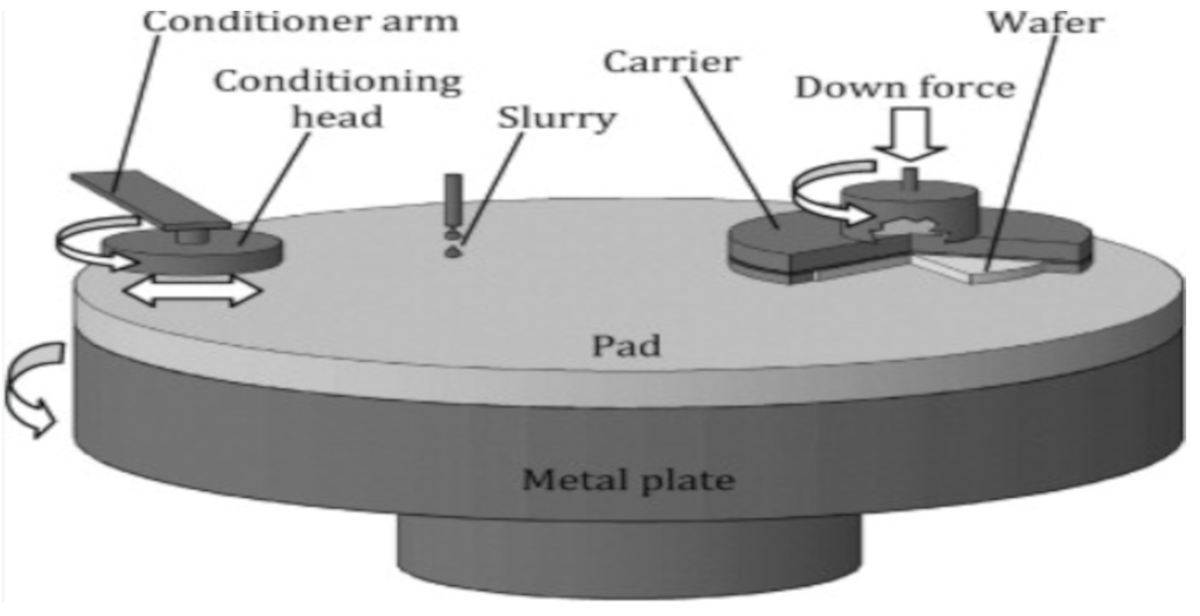
In-situ conditioning dresses the polishing pad simultaneously while a wafer is being polished, maintaining continuous pad roughness and steady removal rates during high-volume production. Ex-situ conditioning dresses the pad between wafer runs, which reduces the risk of loose conditioner debris contacting the wafer during polishing but adds non-productive tool time between wafers.
Why do CMP polishing pads glaze over without conditioning?
During polishing, heat, downforce, and accumulated slurry byproducts flatten and seal the open pores of the polyurethane pad surface—a condition known as pad glazing. A glazed pad cannot hold or transport fresh slurry efficiently, causing wafer material removal rates to drop and planarization uniformity to degrade.
How long does a diamond CMP pad conditioner last?
Conditioner service life varies with downforce, slurry chemistry, and pad hardness, typically ranging from tens to hundreds of active conditioning hours. Disks are retired once tip wear reduces the pad cut rate below process limits or when periodic inspection shows bond erosion that increases the risk of diamond pullout.
Why is active brazing preferred over electroplating for advanced CMP conditioners?
Active brazing forms a chemical carbide bond between the diamond crystal and the braze alloy rather than relying solely on mechanical encapsulation. This stronger bond supports higher diamond protrusion for better debris clearance while reducing the risk of diamond pullout in corrosive CMP slurries.
How does conditioner downforce affect pad cut rate and pad life?
Higher conditioner downforce drives the diamond tips deeper into the polyurethane pad, increasing the pad cut rate and restoring surface roughness more aggressively. However, excessive downforce accelerates pad wear—shortening pad replacement intervals—and places higher shear loads on the bonded diamond grits.
Drafted by: Gareth Bayley
Technical Review & Editing: Ashley Wei