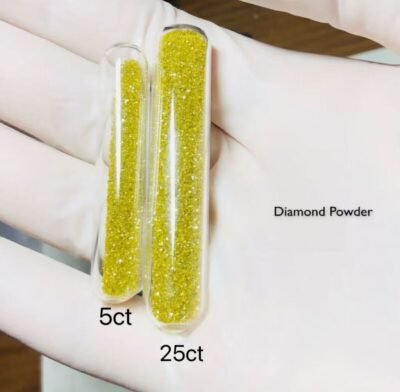
For the super-hard abrasives manufacturing industry , monocrystalline diamond powder occupies a prime position. It is the material of choice for precision manufacturing, from being used as to make a diamond cutting disc to being part of a diamond slurry. When we look at a data-sheet for diamond powder, we typically focus on the obvious metrics: particle size distribution, purity, and shape.
However, lurking beneath these surface-level specifications is a far more critical, yet often overlooked, variable: grain perfection.
Grain perfection refers to the internal crystalline integrity of each individual diamond particle. Is the particle a flawless, continuous lattice of carbon atoms, or is it riddled with hiddne defects, inclusions, and internal stresses? This internal architecture,or lack thereof determines whether a diamond powder will deliver exceptional performance or cause catastrophic failure.
To understand the performance of monocrystalline diamond powder, we must look beyond the particle and into the lattice.

The Anatomy of a Monocrystalline Diamond
A “Mono crystal” diamond is defined by its continuous, unbroken crystal lattice. Unlike poly-crystalline diamond (PCD), which is a composite of many tiny crystallites sintered together, a single crystal is one giant molecule of carbon.
However, “single crystal” does not automatically mean “perfect crystal.” During synthesis—typically via High-Pressure High-Temperature (HPHT) methods—several imperfections can form:
Metallic Inclusions: Tiny droplets of the metal catalyst (e.g., iron, nickel, cobalt) trapped within the growing crystal.
Nitrogen Impurities: Nitrogen atoms substituting carbon atoms in the lattice, creating strain centers.
Dislocations: Line defects where the crystal lattice is misaligned.
Microcracks: Internal fractures caused by rapid thermal or pressure changes during synthesis.
These imperfections are the fault lines for performance failures.
The Mechanics of Failure: Fracture Toughness vs. Friability
The primary function of diamond powder is to abrade. As a particle moves between a lapping plate and a workpiece, it experiences tremendous compressive and shear forces. How the particle responds to these forces defines its performance.
A diamond particle with high grain perfection (few inclusions, low dislocation density) behaves like a flawless gemstone. It exhibits high strength and fracture toughness. Under load, it resists fracturing. It stays whole, cutting with sharp, defined edges for a long time.
Conversely, a diamond particle with low grain perfection (high density of inclusions and dislocations) is a ticking time bomb. These internal defects act as stress concentrators. When force is applied, the particle does not “wear down” in a controlled manner; it shatters.
This phenomenon is known as friability.
While some applications require friable grains that self-sharpen by breaking down, for most high-precision lapping and polishing applications involving single crystal powders, premature friability is a detriment. It leads to:
Inconsistent Cut Rates: As grains shatter uncontrollably, the effective particle size distribution in the slurry changes mid-process.
Increased Subsurface Damage: Shattered grains create sharp, uncontrolled shards that can cause deep scratches (gauging) on the workpiece surface.
Slurry Instability: Fine fragments from shattered particles increase the viscosity of the slurry and alter thermal conductivity, leading to process variability.
Performance in Application
The impact of grain perfection is most visible in three critical application areas.
1. Lapping and Polishing of Semiconductors (SiC, GaN)
Wide-band gap semiconductors like Silicon Carbide (SiC) are notoriously hard and brittle. To achieve a pristine, epi-ready surface, the diamond powder used in the final lapping stages must provide a uniform material removal rate (MRR) without introducing deep scratches.
If the diamond powder contains grains with poor perfection, internal inclusions act as stress concentrators. Under the high pressure required to lap SiC, these imperfect grains explode, creating oversized, angular shards that plow deep furrows into the wafer. The result is a high “scratch density” that renders the wafer unusable. High-perfection diamonds, with their homogeneous strength, maintain their shape under load, delivering consistent micro-cutting and a uniform surface finish.

2. Wire Die Drawing
In the production of wire drawing dies, diamond powder is sintered or bonded into the die’s nib. Here, the wear life of the die is directly proportional to the strength of the individual diamond crystals.
Dies manufactured with low-perfection diamond powder suffer from accelerated wear. As internal dislocations migrate under the cyclical stress of wire passing through, they coalesce, leading to the premature pull-out of entire diamond grains from the matrix. High-perfection crystals, with their superior fatigue resistance, maintain their anchorage in the matrix, extending die life by 300% to 500% compared to standard-grade powders.
3. Superhard Composite Manufacturing
When manufacturing Poly-crystalline Diamond (PCD) compacts for cutting tools, monocrystalline diamond powder is used as the feed-stock. During the high-pressure, high-temperature sintering process, the diamond grains bond to each other (direct diamond-to-diamond bonding).
The presence of metallic inclusions in the feed-stock grains is catastrophic. Under HPHT conditions, these trapped metals (which have a different coefficient of thermal expansion than diamond) expand, creating micro-cracks and weak interfaces. This drastically reduces the transverse rupture strength (TRS) of the final PCD tool. High-perfection diamond powder ensures that the sintered compact achieves maximum density and cohesive strength.

The Characterization Challenge
Historically, quantifying grain perfection has been difficult. While suppliers might label powder as “high grade” or “premium,” the industry has traditionally relied on indirect metrics like bulk magnetic susceptibility (to measure metallic inclusions) or visual inspection under a microscope.
Modern characterization now leverages advanced techniques to provide transparency:
Magnetic Susceptibility: High levels of magnetism indicate trapped metallic inclusions, signaling poor perfection.
Nitrogen Content Analysis: FTIR spectroscopy can quantify isolated nitrogen defects (Type Ib diamond), which correlates with internal strain.
Static Crush Strength Testing: Measuring the force required to fracture individual particles provides a direct statistical distribution of grain strength.
In the pursuit of nano-metric surface finishes and micron-level tolerances, the quality of the abrasive tool cannot be separated from the quality of its constituent particles. While particle size and shape are visible to the naked eye (under magnification), grain perfection is the invisible variable that dictates consistency.
Monocrystalline diamond powder with high grain perfection offers predictable fracture mechanics, consistent material removal rates, and superior surface integrity. As manufacturing tolerances continue to tighten—moving towards atomic-scale precision—the demand for diamond powder characterized not just by what it is, but by the perfection of its internal structure, will become the new standard.
Selecting diamond powder based solely on grit size is a gamble. To control the process, one must first control the crystal.
#monocrystallinediamondpowder #diamondpowder #syntheticdiamondpowder #syntheticdiamond #coateddiamondpowder #crusheddiamondpowder #diamondlappingpowder #thermalconductivediamondpowder