Diamond Powder Price Guide: What Affects the Cost?
If you've requested quotations from multiple synthetic diamond powder suppliers, you've probably noticed that prices can vary significantly—even for products with the same nominal particle size.
Particle size is only one factor. Crystal strength, particle shape, PSD, purity, thermal stability, surface treatments, and customization all influence manufacturing cost.
This guide explains where these price differences come from and how to evaluate quotations based on total application cost rather than price per kilogram.
Application Is the Primary Driver of Diamond Powder Pricing
Different applications place different performance requirements on diamond abrasive powder, resulting in significant differences in manufacturing cost. The raw diamond itself may be similar, but different applications require different levels of crystal strength, particle shape, particle size, particle size distribution (PSD), purity, thermal stability, and customization1. These performance requirements ultimately determine the manufacturing cost.
The table below summarizes how different applications influence diamond powder pricing.
| Application | Typical Uses | Main Price Drivers |
|---|---|---|
| Bulk Cutting & Drilling | Granite saw blades, concrete cutting, core drills, loose abrasive grit | Requires large, blocky crystals with high strength and good impact resistance2. These crystals have lower production yield and therefore higher manufacturing cost. |
| Precision Grinding | Resin-bond and metal-bond grinding wheels, carbide grinding, tool sharpening | Requires consistent crystal strength, controlled particle shape, and in many cases coated diamond powder3 to improve bond retention and heat resistance. These additional processing steps increase cost. |
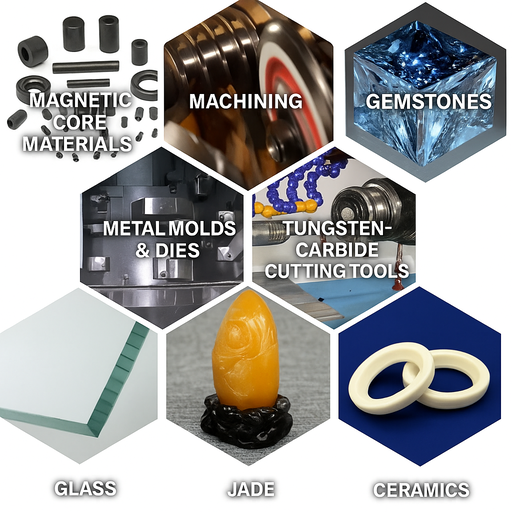
| Lapping & Polishing | Tungsten carbide, ceramics, sapphire, optical glass, precision molds | Surface finish becomes the priority. Narrow particle size distribution (PSD), high purity, and highly consistent micron diamond powder are required to minimize scratches and achieve stable polishing performance. |
| High-Tech & Medical | Semiconductor CMP, optical components, medical devices, aerospace composites | Requires the highest levels of purity, ultra-fine particle size, tight PSD, near-spherical particles, and extensive quality control4. These demanding specifications make this the highest-value category of diamond powder. |
As application requirements become more demanding, tighter manufacturing tolerances, additional processing steps, and stricter quality inspection are required. In other words, customers are not simply paying for the diamond powder itself—they are paying for consistent performance, predictable tool life, and reliable production results.
The following sections explain how each factor affects diamond powder pricing, including crystal strength, particle shape, particle size, PSD, purity, and customization.
How Diamond Powder Strength Influences Price
Match the diamond powder strength to your application requirements to achieve the best balance between cost and performance.

High-strength monocrytalline diamond powders monocrystalline diamond powders are designed for demanding cutting and grinding applications where maximum tool life, wear resistance, and thermal stability are required. Producing these grades requires tighter control of crystal growth, stricter quality grading, and lower production yield5, resulting in a higher manufacturing cost. In return, they deliver longer tool life, more stable performance, and lower overall production costs in high-load applications.
Medium- and economy-strength diamond powders provide a more cost-effective solution for general-purpose cutting, grinding, lapping, and polishing applications. Although they do not offer the same level of durability as premium grades, they still provide excellent performance for many industrial processes, including precision machining and finishing[2]. Choosing a higher-strength grade than your application actually requires often increases material cost without delivering meaningful performance benefits6.
Ultimately, the most expensive diamond powder is not always the most economical choice. Selecting the appropriate crystal strength for the application provides the best overall cost-performance balance.
However, crystal strength is only one factor affecting price. Even diamond powders with similar strength can vary significantly in cost because of differences in particle shape, which is discussed in the next section.
How Particle Shape Impacts Price
Diamond powder can be manufactured with different particle morphologies7, each designed to optimize cutting behavior, surface finish, and tool performance for specific applications.Particle shape is controlled during crushing, shaping, and classification processes.
| Particle Shape | Pricing | Best For | Cost Factor |
|---|---|---|---|
| Angular | Lowest Cost | Applications where aggressive cutting and fast material removal are priorities, and surface finish is less critical. | Produced by basic crushing with no additional shaping steps. The process is straightforward and requires minimal processing. |
| Irregular | Low to Medium Cost | General-purpose applications needing a trade-off between cutting efficiency and durability. | Requires some screening and classification to achieve a balanced mix of crystal forms, adding a modest processing step. |
| Blocky | Medium Cost | High-strength applications like sawing, drilling, and metal-bond grinding where tool life and crystal retention are critical. | Requires controlled crushing and shaping processes to produce uniform, load-bearing crystals. The extra manufacturing steps increase production time and cost. |
| Near-Spherical | Highest Cost | High-precision polishing, optics, dies, and semiconductors where minimizing scratch depth and achieving superior surface quality8 are essential. | Demands advanced reshaping technologies to round particles and achieve extreme uniformity. This complex, multi-step process significantly raises production costs. |
More uniform and application-specific particle shapes require additional processing and stricter quality control, resulting in higher manufacturing costs. However, these extra steps improve process consistency and surface finish in demanding applications.
Besides particle shape, particle size is another major factor influencing the price of diamond powder. The following section explains how different particle sizes affect manufacturing cost.

Why Does Diamond Powder Particle Size Affect Cost?
Particle size influences manufacturing cost, but there is no universal pricing rule. The relationship between particle size and price depends on the product category and the manufacturing process. In some products, larger particles are more expensive because they are more difficult to grow. In others, finer particles command a premium because of the additional crushing, classification, and quality control required.
| Diamond Powder Type | Typical Size Range | General Pricing Trend | Main Reason |
|---|---|---|---|
| Saw Grit Diamond | 18/20–50/60 mesh | Larger particle size → Higher price | Large, blocky crystals require longer growth time and have lower production yield. |
| Wheel Grit Diamond | 60/70–500/600 mesh | Finer particle size → Higher price | Smaller particles require additional crushing, multi-stage classification, and grading. |
| Micron Diamond Powder | 0.5-50 μm | Mainly determined by grade | Price depends more on crystal strength, PSD, and purity than on particle size itself. |
| Crushed Diamond Powder | Available in mesh and micron sizes | Relatively stable within the same grade | Processing and classification costs remain relatively consistent across most size ranges. |
| Nano Diamond Powder | 5–250 nm | Smaller particle size → Higher price | Ultra-fine particles require complex classification, dispersion, and contamination control. |
As a result, particle size should never be evaluated in isolation when comparing quotations. The final price depends not only on the nominal particle size, but also on the manufacturing method, production yield, and quality requirements for each product category.
However, particle size alone does not determine product consistency. Manufacturers must also control particle size distribution (PSD), which has a significant impact on production cost and application performance. The next section explains why a narrower PSD typically results in a higher-priced diamond powder.
Why Does a Narrow Particle Size Distribution (PSD) Cost More?
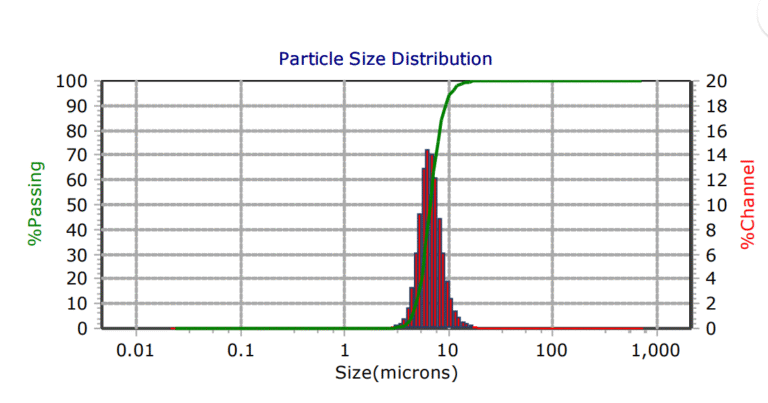
For micron diamond powder, particle size alone does not fully describe product quality. Manufacturers also control the particle size distribution (PSD), commonly measured by D10, D50, and D909, which indicate how tightly the particles are distributed around the target size.
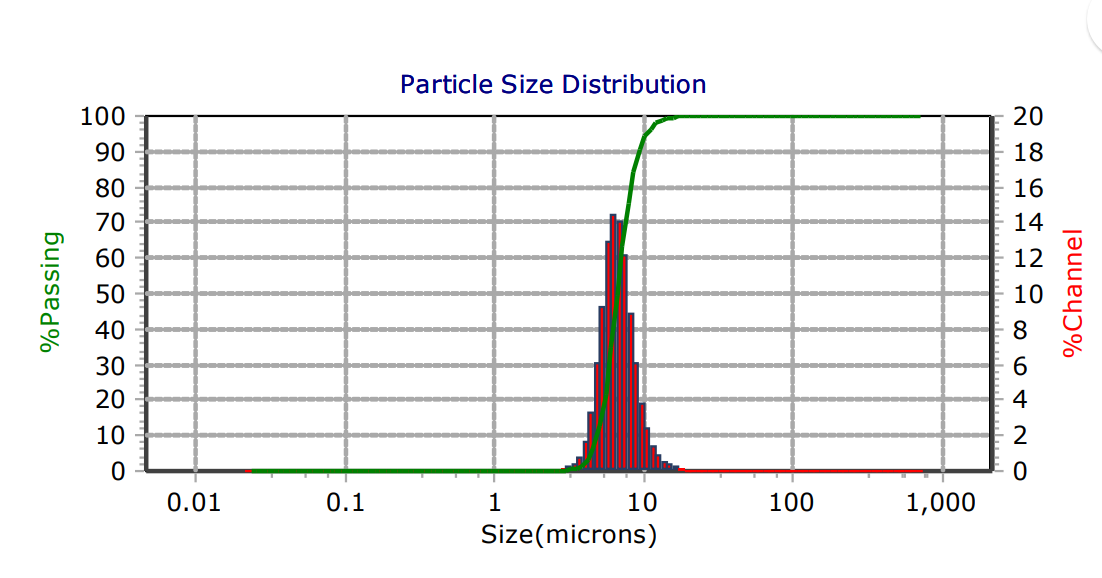
Typical laser particle size distribution (PSD) analysis showing D10, D50, and D90 values.
A narrow PSD requires additional crushing, multi-stage classification, repeated laser particle size analysis, and stricter quality control. These extra processes reduce production yield and increase manufacturing cost.
The benefit is more consistent polishing performance, fewer deep scratches, and better surface quality. This is especially important for optical polishing, semiconductor materials, sapphire, precision ceramics, and other ultra-precision applications.
Tip: Two diamond powders with the same nominal size (for example, 6–12 μm) can perform very differently if their PSD is different. A narrower PSD generally delivers more consistent results and therefore commands a higher price.
Besides PSD, another important factor affecting price is the chemical purity of the diamond powder.
Why Purity and Thermal Stability Increase Cost
Purity
High-purity diamond powder requires additional purification and quality control to remove metallic impurities, graphite, and other contaminants. These extra processes increase manufacturing cost but reduce scratches, improve bonding, and minimize scrap rates in precision grinding and polishing applications.High-purity grades are particularly important for precision polishing, semiconductor, and optical applications.
Thermal Stability
Diamond powders with higher thermal stability require higher-quality raw crystals and tighter production control. Although they cost more, they provide longer tool life, more consistent wear, and greater reliability in high-temperature applications such as metal-bond tools and brazed diamond tools.
Higher purity and better thermal stability increase the initial purchase price, but they often reduce overall production costs by minimizing rework, tool failures, and downtime.
How Customization Requirements Affect Cost
Most industrial applications can be served by standard diamond powder grade. However, customized specifications often require additional processing, testing, and quality control, which increase manufacturing cost.
How Customisation Requirements Affect Cost
| Customization Requirement | Why It Increases Cost |
|---|---|
| Coatings and Surface Treatments | Metallic or ceramic coatings (Ni, Cu, Ti, TiC, etc.) and surface treatments such as roughening require additional processing, materials, and quality control to improve bonding, wear resistance, or thermal performance. |
| Particle Shape Customization | Producing blocky, angular, rounded, or specially fractured particles requires controlled crushing, shaping, and classification, reducing production yield and increasing manufacturing complexity. |
| Specialized Diamond Structures | Engineered structures such as porous, multilayer, or other application-specific diamond particles require additional synthesis or post-processing steps. |
| Custom PSD and Purity | Narrow particle size distributions and ultra-high purity grades require extra classification, purification, and inspection to meet demanding application requirements. |
| Order Quantity and Packaging | Small production batches increase setup costs, while customized packaging such as vacuum-sealed, moisture-barrier, or anti-static packaging adds material and handling costs. |
Every customization adds processing steps, quality control, or material costs. The final price therefore reflects not only the diamond powder itself, but also the engineering required to optimize it for a specific application.
How to Get an Accurate Diamond Powder Quote
There is no single diamond powder grade that suits every application. The most cost-effective choice depends on the application requirements, required tool life, material removal rate, surface finish, and production efficiency rather than a single specification.
Two diamond powders with similar particle sizes may require completely different grades and manufacturing processes depending on the application10, resulting in different quotations.
To recommend the most suitable grade and provide an accurate quotation, the following information is usually required:
- What material is being processed?
- What particle size or diamond grade is currently being used (if known)?
- Is the application cutting, grinding, lapping, or polishing?
- What bond system is being used (if applicable)?
- Are there any current issues, such as excessive wear, glazing, poor surface finish, or inconsistent tool life?
- What performance improvements are expected?
The more application information provided, the more accurately the diamond powder can be matched to the process.
Based on this information, Crownkyn Diamond, as an experienced industrial diamond powder manufacturer, can recommend a suitable starting grade for testing and help optimize the specification based on actual application results.
Conclusion
There is no universal "best price" for synthetic diamond powder. The right choice depends on balancing performance requirements with manufacturing cost. Crystal strength, particle shape, particle size, PSD, purity, thermal stability, and customization all contribute to the final quotation11 because each requires additional manufacturing processes and quality control.
Instead of comparing prices alone, evaluate how well a diamond powder matches your application. A grade that costs more initially may provide longer tool life, better surface quality, and lower total production costs over time.
If you need help selecting the most cost-effective diamond powder for your application, Crownkyn Diamond can recommend a suitable starting grade for evaluation, testing, and process optimization.
Reference
Supports the influence of particle size distribution (PSD), morphology, crystal strength, purity, and thermal behavior on abrasive performance.
Supports the use of large, blocky, high-strength diamond grits for cutting and drilling applications.
Supports the benefits of nickel-, copper-, titanium-, and carbide-coated diamond powders for improved bonding and thermal performance.
Supports the importance of particle size, PSD, particle shape, dispersion, and purity in precision polishing and CMP applications.
Supports the relationship between crystal growth control, quality grading, production yield, and synthetic diamond quality.
Supports selecting diamond strength according to application requirements rather than always choosing the highest grade.
Supports the classification of diamond particle morphologies such as angular, blocky, irregular, and rounded crystals.
Supports the effect of particle shape and size distribution on scratch depth and polishing quality.
Defines the standard PSD parameters D10, D50, and D90 used in particle size analysis.
Supports the influence of particle size, morphology, friability, thermal stability, and bond interaction on abrasive performance.
Supports the use of particle size distribution, particle shape, purity, crystal strength, and thermal behavior as key quality parameters for industrial powders.
Characterization and Evaluation of Synthetic Diamond Abrasives – North Carolina State University ↩
Statistical and Microscopic Investigation of Diamond Saw Segments ↩
Interfacial Characterization and Thermal Conductivity of Diamond Composites – MDPI ↩
A Comprehensive Review of Nano-Abrasive Key Parameters – MDPI ↩
HPHT and CVD Diamond Growth Processes – GIA ↩
Grinding and Other Abrasive Processes – Michigan State University ↩
Etch Features Reveal the Morphology of Diamond – GIA ↩
Influence of Abrasive Particle Size on Surface Properties – PubMed ↩
Analysis of Particle Size Distribution – Microtrac ↩
Microstructural Characterisation and Wear Behaviour of Diamond Abrasives – MDPI ↩
NIST Recommended Practice Guide: Particle Size Characterization ↩